
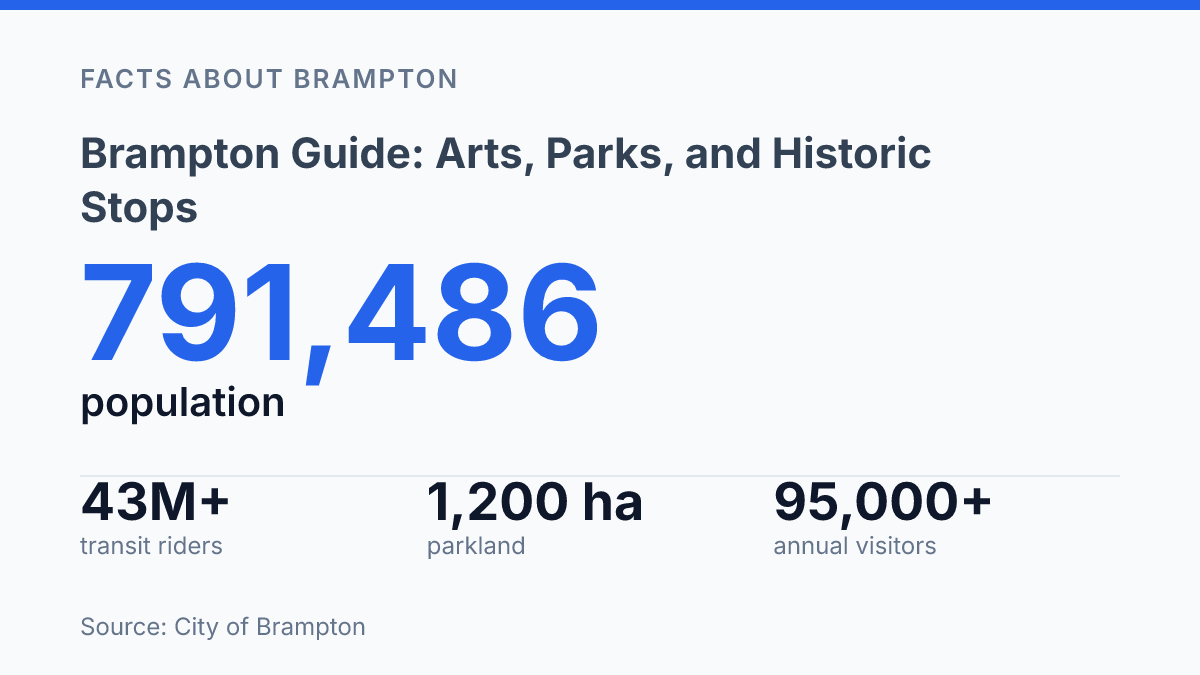
Brampton isn’t a minor Toronto suburb. With 791,486 people in 2024, it now outranks many Canadian cities that get far more attention.
That scale changes how you should read the place. The transit numbers alone make the point: more than 43 million riders moved through the city in 2024.
This is not a quiet edge of the GTA. It’s a city with its own rhythm, its own pressure, and its own reasons to stay after dark.
The useful guide starts where the lazy one stops. Downtown has stages, screens, and public squares. The Rose anchors a performing arts scene with 60-plus productions a season.
Heritage sites pull the story back to farmhouses, archives, and old civic buildings. Then the parks complicate the picture again. In my honest opinion, the real surprise is how much of local life happens outside the obvious attractions.
Where Brampton sits in the GTA
A city estimated at almost 800,000 people changes the map west of Toronto from suburbia to a place with its own gravity. Brampton is a Canadian city in Ontario’s Greater Toronto Area, but treating it as a smaller echo of Toronto misses the point.
The scale is plain: in 2024, the city estimated 791,486 residents, making it Canada’s seventh-largest city, Ontario’s third-largest. The GTA’s second-largest, according to the City of Brampton, 2024 Annual Report.
That rank matters. It tells you this isn’t just a stop between places.
Its place inside Peel Region also explains how people tend to arrive. Toronto sits to the east.
Mississauga borders the route south and southeast. Highways and regional transit shape many trips before visitors even choose what to see.
That location creates a useful tension. The city is close enough to Toronto for day trips, commuter patterns, and cross-GTA travel to feel normal. Yet the distance is real.
You notice it in the street rhythm, the spacing between districts. The way local life doesn’t orbit downtown Toronto as tightly as outsiders expect.
In my view, that separation is the first thing to understand before planning a visit. If you expect a Toronto neighbourhood, you’ll read the place wrong.
Approach it as a large GTA city with its own centre of gravity.
Downtown arts and evening culture
A downtown night can move from an 850-seat mainstage ticket to a free film on a 24-foot screen in less than a minute’s walk. That tight pairing gives the core its cultural charge. The Rose Theatre anchors the formal side of downtown Brampton, with a Mainstage built for concerts, comedy, dance, theatre, and touring acts that need a proper room.
Scale matters here. Each season includes 60+ productions or performances, with spaces ranging from the 850-seat Mainstage to a 100-seat black box Studio, according to the city’s 2026 Performing Arts page. That range lets the venue host both polished headline shows and smaller work that feels closer to the artists.
It’s not just a hall. It’s a scheduling engine for evening activity.
Step outside, though. The mood changes fast. Garden Square sits in front of the theatre and trades ticketed quiet for public noise.
Its screen, plaza setup, and open sightlines make it a natural place for movie nights, pop-up performances, civic events, and casual meetups. In 2024, the PIXEL Digital Art Exhibition was set to show work by up to 50 local artists on the square’s 24-foot LED screen, with selected artists paid for their pieces.
The useful contrast is not “inside versus outside.” It’s controlled programming versus open programming. The theatre asks you to choose a show, buy in, sit down, and pay attention.
The square lets you drift in, catch ten minutes, meet friends, or stay for two outdoor movies on a summer night. Both matter. They don’t create the same crowd.
That difference is the point. In my honest opinion, the downtown core works best when it doesn’t try to make every cultural experience feel formal. A stage can give a performance weight.
A square can make culture feel unplanned and shared. Together, they give the evening scene more than one speed.
Museums and heritage buildings worth seeing
The city’s strongest heritage lesson is a split-screen: courthouse-era masonry downtown, then a lived-in Victorian farmhouse miles north. At Peel Art Gallery, Museum and Archives, the past doesn’t sit behind one neat facade.
The institution occupies 19th-century buildings joined with contemporary additions. The architecture itself tells you that local memory keeps getting edited.
That mix matters. Old brick gives the place civic weight.
The newer spaces make room for changing exhibitions, archives, school visits, and community programming. According to a City news release, the complex covers 60,879 sq. ft. and holds recorded artifacts, archaeological objects, and art collections at serious scale.
A major shift is coming on January 1, 2028, when ownership and operation of PAMA are set to move from the regional level to the municipality. That sounds administrative.
It changes how the site can be read. A museum tied more directly to the city can speak with sharper local focus, if it resists becoming just another civic showcase.
Historic Bovaird House gives the contrast real bite. It’s not a gallery complex or archive hub. It’s a restored Victorian-era domestic site in the north end, centered on a circa 1852 Georgian-style farmhouse in a two-acre park-like setting, with the older Pendergast Log House nearby, according to Historic Bovaird House.
That split is the point. The city’s heritage isn’t preserved in one frozen district where every building performs the same version of the past. It sits between curated museum rooms and a single old home that still carries the shape of residential life. In my humble opinion, that makes the history feel less polished, and much more useful.
If you visit both, you read the city differently. PAMA shows public memory: records, collections, institutions, civic architecture. Bovaird House shows private memory: rooms, gardens, furniture.
The slower habits of household life. The gap between them says more than either place can say alone.
Parks and public spaces that shape local life
According to a March 2024 municipal release, the parks system held 1,200 hectares of parkland. The most telling green space may be one compact downtown park. That same release counted 425 parks and 346 playgrounds.
The outdoor network is not a side feature. It’s part of daily civic life.
At Gage Park, the floral gardens do more than decorate the centre of town. They soften it. The clipped beds, mature trees, and open lawns create a formal pause beside streets built for errands, traffic, food stops, and quick crossings.
That polish creates a useful contrast with the urban core around it. You can leave a hard-edged block and enter a space that asks for slower movement within seconds. In my view, the park’s real value is that it lets downtown breathe without asking anyone to buy a ticket.
Public gathering gives the park its deeper role. People use it for photos, casual walks, meetups, family time, and moments when they don’t need a programmed event to justify being downtown. But that openness is also the tradeoff: a public park has to serve quiet visitors and crowds without becoming only one thing.
Scale matters here, but intimacy matters more. The city may count its green space by the hundreds of hectares, yet Gage Park works because it feels readable and close at hand.
The strongest public spaces aren’t all indoors. A garden path can matter as much as a theatre seat when people want a slower pace.
What first-timers miss once the map looks simple
The smartest next step is not to treat the city as a checklist. Pick one anchor, then let the nearby streets, parks, and evening events change the plan.
That approach will matter even more when PAMA transfers to city operation on January 1, 2028. A 60,879-square-foot cultural complex gives Brampton a stronger hand in telling its own story, but size alone won’t do the work. Programming will.
The same is true outdoors. The planned 250 hectares of new recreation parkland can reshape daily life if it connects neighbourhoods, not just fills maps. In my humble opinion, that’s the test for any growing city: not how many places it can name, but how many people can actually use them.
Frequently Asked Questions
Q: What is Brampton best known for?
A: Brampton stands out for its mix of arts, parks, and heritage stops. The Peel Art Gallery, Museum and Archives sits in both 19th-century and contemporary buildings. The Rose Theatre anchors downtown with live performances. In my view, that mix gives the city more range than people expect.
Q: Is there anything to do downtown in Brampton at night?
A: Yes. The Rose Theatre draws major shows, and Garden Square in front of it hosts big-screen movies and live events. That makes downtown feel active without trying too hard…
Q: Which park should I visit in Brampton for flowers and a walk?
A: Gage Park is the clear pick if you want floral gardens and an easy stroll. It’s one of the city’s best green spaces. It feels different from a formal tourist stop. You can slow down there and still stay close to the center of the city.
Q: Where can I learn about Brampton history?
A: Historic Bovaird House is the place to start. It’s a Victorian home to the north. It gives you a direct look at the city’s past without a lot of noise around it. That contrast is the point.
Q: What’s the best way to combine arts and outdoor spots in Brampton?
A: Pair the Peel Art Gallery, Museum and Archives with Gage Park or Garden Square. You’ll get museums, performances, and open-air spaces in one trip, which keeps the day from feeling one-note. Brampton makes that easy because the key stops sit close enough to connect.